
Menu
In offshore and industrial environments, electrical systems are far more than a network of cables and components. They are an invisible infrastructure that keeps critical operations running, safeguards personnel and ensures equipment performs under relentless conditions. Within modular electrical buildings, three elements form the core of this ecosystem: Variable Frequency Drives (VFDs), Motor Control Centers (MCCs) and switchgear.
Though often grouped together, each plays a different role. Understanding how they interact offers clarity into how power is controlled, protected and optimized in demanding environments.
The Foundation of Modern Power Control
At the heart of any offshore electrical system is the challenge of managing power efficiently while ensuring reliability. Power arrives from generators or shore connections and first encounters switchgear: the system’s primary gatekeeper. Switchgear governs the flow of electricity, ensuring it is safely distributed while protecting the network against faults, overloads or short circuits that could jeopardize equipment or operations.
From there, power is routed to MCCs. These centers act as operational command hubs, organizing and managing power delivery to individual motors that drive pumps, compressors and other essential equipment. Within these centralized enclosures, control devices and protective systems work in unison to ensure motors operate within safe limits and can be isolated when maintenance is required.
For applications demanding tight control over motor performance, VFDs enter the equation. Rather than allowing motors to run at a fixed speed, VFDs fine-tune motor output by adjusting frequence and voltage. This enables precise speed control, smoother startups and significant energy savings.
How These Systems Work in Harmony
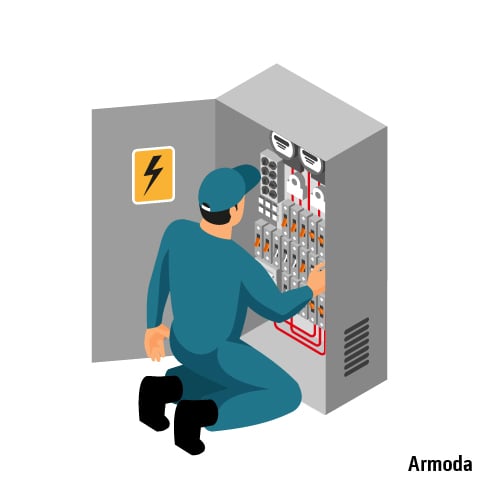
The true strength of these components lies in their integration. In a typical offshore modular structure, power flows in a carefully orchestrated sequence: switchgear receives and protects incoming supply, MCCs distribute that power to motor loads and VFDs regulate how those motors perform.
This coordinated relationship allows operators to move from raw power intake to refined controlled output, ensuring that each motor responds exactly as required. Whether controlling flow rates in produced-water systems or maintaining stable pressure in compressor operations, the synergy between these systems transforms electrical energy into precise mechanical performance.
Offshore Reality: Where Design Meets Durability
Offshore environments introduce variables that few onshore facilities encounter: salt-laden air, humidity, vibration, limited space and the constant need for uninterrupted operation. Electrical systems need to perform and endure.
In these conditions, the design of VFDs, MCCs and switchgear becomes as important as their function. Enclosures must withstand corrosive atmospheres and meet strict environmental ratings. Systems often require hazardous area certifications to comply with standards for explosive atmospheres. Ventilation, heat dissipation and component spacing must be carefully engineered to prevent thermal stress and maintain constant performance.
The modular nature of modern offshore electrical buildings offers a strategic advantage. Factory-assembled and fully tested systems reduce on-site complexity, shorten commissioning timelines and minimize the risks associated with offshore installation work.
Offshore Requirements
Compliance is critical in the offshore sector. In most cases, these buildings must meet rigorous standards set by governing bodies like the American Bureau of Shipping (ABS), the United States Coast Guard (USCG) or Det Norske Veritas (DNV). These certifications go beyond simple paperwork; they verify that the structure and its internal systems are engineered to withstand harsh marine environments and explosive atmospheres. By strictly complying with these regulations, operators ensure the safety of their personnel and minimize the liability risks associated with non-compliant infrastructure.
Cost and Time Savings
The modular approach offers significant advantages over traditional stick-built methods. By fabricating and installing equipment in a controlled manufacturing facility, projects avoid the logistical complexity and high labor costs of offshore construction. This “plug-and-play" model allows for comprehensive factory acceptance testing before shipment. Customers gain the assurance that all functionality operates as designed, ensuring that when the model arrives on-site, commissioning is streamlined and the system comes online much faster, with no unexpected delays.
Large Single-Lift Capabilities
A key evolution in this field is the ability to fabricate these electrical buildings as large, single-lift structures. Rather than piecing together smaller modules on the platform—which introduces potential seal failures and structural weakness—a single-lift design offers superior scalability and operational resilience. These massive, fully integrated units can be hoisted onto the platform in one move, reducing installation interfaces and ensuring a weather-tight, robust environment for sensitive VFDs, MCCs and switchgear on day one.
Beyond Function: Designing for Longevity
The most effective electrical systems are those built for performance, accessibility and endurance. Equipment must be serviceable in environments where time, safety and logistics are at a premium. Features like withdrawable units, remote diagnostics and intelligent monitoring systems allow operators to predict issues before failures occur, reducing downtime and extending equipment life.
This foresight is a fundamental element of operational reliability in facilities where power failure can carry significant safety, financial and environmental consequences.
Building Systems That Withstand the Toughest Conditions
Creating cohesive, high-performance electrical systems requires more than assembling components. It demands a strategic approach that balances engineering precision, regulatory compliance and real-world practicality. The more successful installations prioritize modularity, factory testing and integrated design from the earliest planning stages.
At Armoda, this philosophy guides every project. By delivering turnkey, offshore-hardened electrical buildings that integrate VFDs, MCCs and switchgear into unified systems, we help clients operate with confidence in environments where reliability is not optional. Our focus on hazardous area compliance, large single lift structures, scalability and operational resilience ensures power systems that meet standards and exceed expectations.
The Bigger Picture
Power distribution in offshore settings is never simply about electricity. It’s about ensuring continuity, protecting assets and enabling operations to perform seamlessly despite environmental and operational complexity. When designed with intention and executed with expertise, VFDs, MCCs, and switchgear become more than equipment; they become the foundation of dependable, efficient offshore infrastructure.
Armoda delivers turnkey offshore electrical buildings that integrate VFDs, MCCs, and switchgear into fully tested, single-lift modules. Connect with our team to discuss your project requirements.